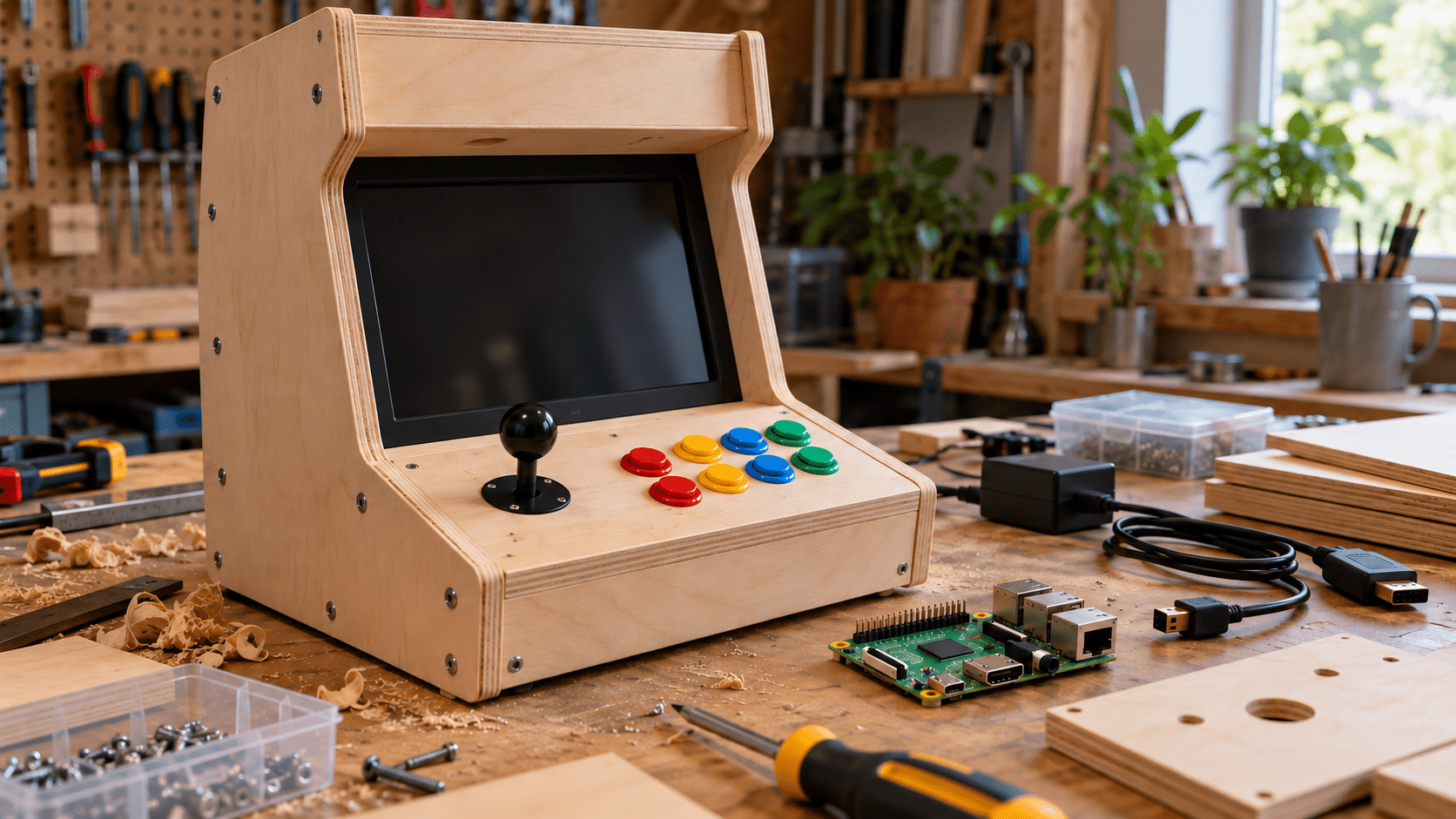
Building your own arcade cabinet is an approachable project, halfway between electronics, woodworking and video games. Here is the hardware to plan for a reliable result.
Key takeaways
- The brain: a recent Raspberry Pi handles most arcade games and 8/16-bit consoles. A mini PC helps for more demanding systems.
- Storage: a quality microSD card or, better, a USB SSD for reliability.
- Controls: arcade joysticks and buttons through a USB encoder, recognised as a standard gamepad.
- The screen: a 4:3 monitor or a 16:9 display with black borders, depending on the games.
Power and sound
An official power supply avoids most unexplained crashes. For sound, two small powered speakers are enough; add an accessible master switch to turn everything on at once.
Software
Dedicated distributions provide a game selection interface and control mapping. Only use games you own the rights to or titles that are legally distributed.
Practical tip
Test the whole electronic setup on a table before building the cabinet. Fixing wiring inside a closed cabinet is far more painful than on a workbench.